by Domiciano de Souza, A., Driebe, T., Chesneau, O., Hofmann, K-H., Kraus, S., Miroshniichenko, A.S., Ohnaka, K., Petrov, R.G., Preibisch, Th., Stee, Ph. Weigelt, G.
We have obtained the first high spatial and spectral resolution observations of the circumstellar envelope (CSE) of a B[e] supergiant (CPD −57? 2874), performed with the Very Large Telescope Interferometer (VLTI). Spectra, visibilities and closure phase were obtained using the beam-combiner instruments AMBER (near-IR interferometry with three 8.3 m Unit Telescopes or UTs) and MIDI (mid-IR interferometry with two UTs). The interferometric observations of the CSE are well fitted by an elliptical Gaussian model with FWHM diameters varying linearly with wavelength.
Typical diameters measured are ~ 1.8 × 3.4 mas or ~ 4.5 × 8.5 AU (adopting a distance of 2.5 kpc) at 2.2 μm, and ~12 × 15 mas or ~ 30 × 38 AU at 12 μm. The size of the region emitting the Brγ flux is ~2.8 × 5.2 mas or ~7.0 × 13.0 AU. The major-axis position angle of the elongated CSE in the mid-IR (~144? ) agrees well with previous polarimetric data, hinting that the hot-dust emission originates in a disk-like structure.
In addition to the interferometric observations we also present new optical (U BV Rc Ic ) and near-IR (JHKL) broadband photometric observations of CPD −57? 2874. Our spectro-interferometric VLTI observations and data analysis support the non-spherical CSE paradigm for B[e] supergiants. These results are described in A&A, 464, 81
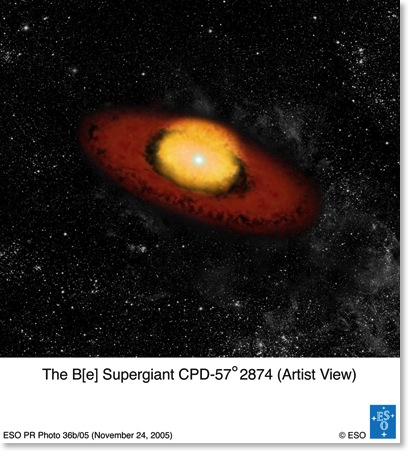
The following image was done by my PhD student Anthony Meilland and can be found on the ESO press release HERE.

Fast ray-tracing algorithm for circumstellar structures (FRACS)
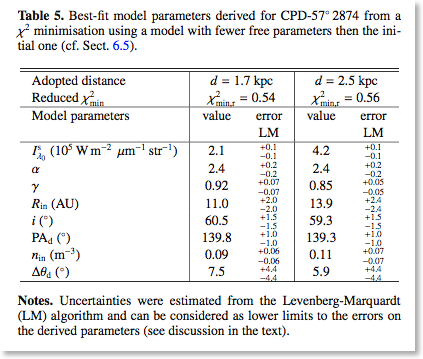
II. Disc parameters of the B[e] supergiant CPD-57°,2874 from VLTI/MIDI data
by A. Domiciano de Souza, P. Bendjoya, G. Niccolini, O. Chesneau, M. Borges Fernandes, A. C. Carciofi, A. Spang, P. Stee and T. Driebe, 2011, A&A, 525, A22
B[e] supergiants are luminous, massive post-main sequence stars exhibiting non-spherical winds, forbidden lines, and hot dust in a disc-like structure. The physical properties of their rich and complex circumstellar environment (CSE) are not well understood, partly because these CSE cannot be easily resolved at the large distances found for B[e] supergiants (typically  1 kpc).
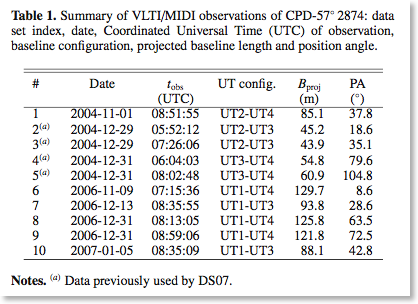
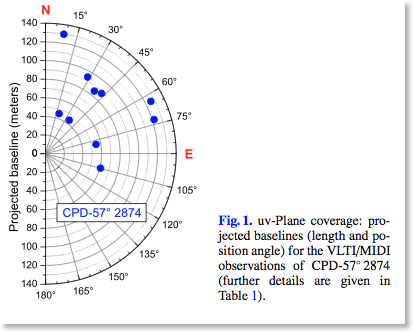
From mid-IR spectro-interferometric observations obtained with VLTI/MIDI we seek to resolve and study the CSE of the Galactic B[e] supergiant CPD-57° 2874.
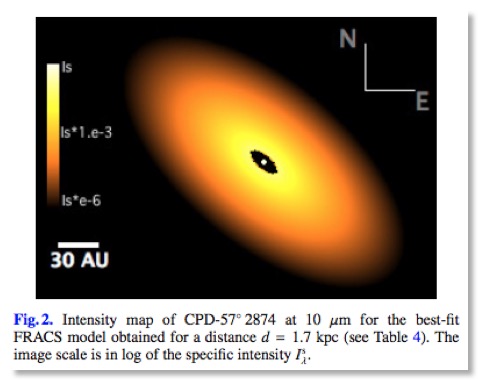
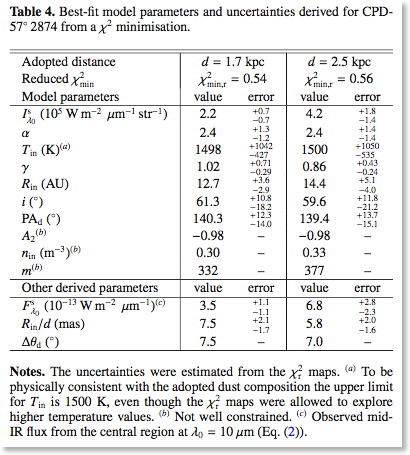
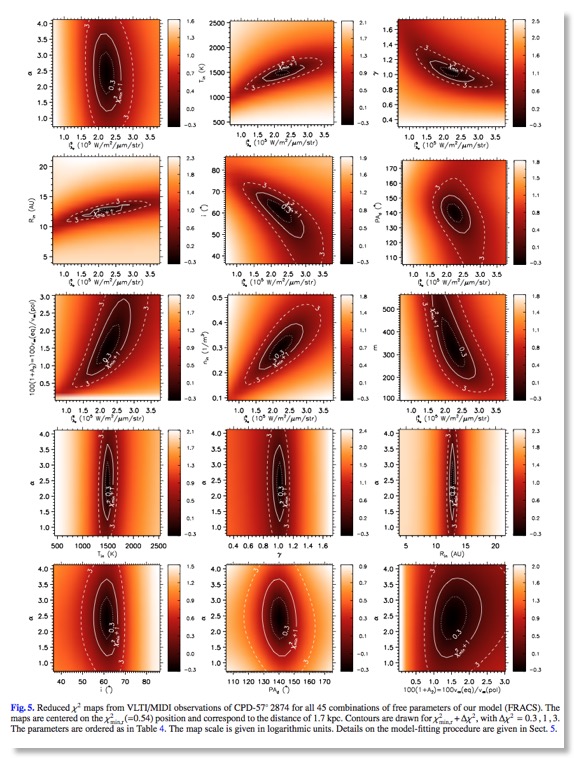
For a physical interpretation of the observables (visibilities and spectrum) we use our ray-tracing radiative transfer code (FRACS), which is optimised for thermal spectro-interferometric observations.
Thanks to the short computing time required by FRACS (<10 s per monochromatic model), best-fit parameters and uncertainties for several physical quantities of CPD-57° 2874 were obtained, such as inner dust radius, relative flux contribution of the central source and of the dusty CSE, dust temperature profile, and disc inclination.
The analysis of VLTI/MIDI data with FRACS allowed one of the first direct determinations of physical parameters of the dusty CSE of a B[e] supergiant based on interferometric data and using a full model-fitting approach. In a larger context, the study of B[e] supergiants is important for a deeper understanding of the complex structure and evolution of hot, massive stars.